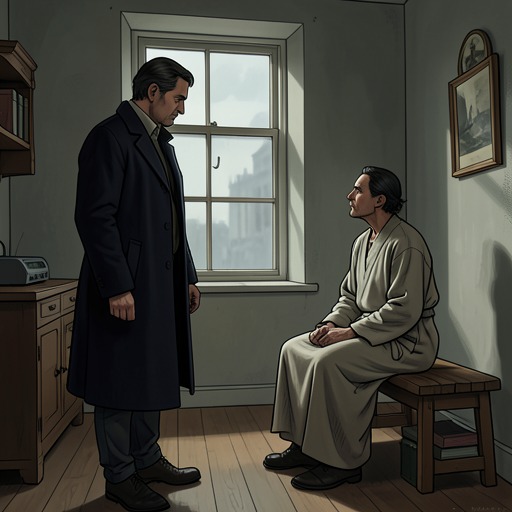
Mihail’s public confession
The Brothers KaramazovMihail’s public confession turns a crime he has concealed for fourteen years into a spoken accusation against himself, supported by the objects he says he kept as proof. Yet the public act does not secure public recognition: his listeners doubt his sanity, and the legal authorities ultimately abandon the case. The confession’s force lies in the contrast between Mihail’s insistence that he wants to suffer for his sin and the community’s refusal to treat his disclosure as credible.
The birthday gathering
The confession takes place at a large gathering held on Mihail’s birthday, an annual occasion attended by people from the town. The narrator had not known the date was his birthday and had been out of contact with others for several days; the revelation arrives not through private conversation but as a public scene. After dinner, Mihail walks to the middle of the room with a paper in his hand. The chief of his department is present, giving the declaration an official recipient even as Mihail reads it aloud to the whole assembly.
The paper contains a full account of the crime, described in every detail. Mihail does not merely allude to a buried past or confess in private: he chooses a crowded occasion and makes the account audible to witnesses. The movement from the room’s ordinary gathering to the declaration’s formal reading gives his confession the shape of both a personal reckoning and a public submission to judgment.
Words and evidence
At the conclusion of the declaration, Mihail presents his self-understanding in the language of guilt, isolation, and religious visitation: “I cut myself off from men as a monster. God has visited me,” he said in conclusion. “I want to suffer for my sin!” The statement joins recognition of his separation from other people to a wish for punishment. His action is therefore more than the disclosure of a crime: he asks to be understood as a person responsible for it and willing to bear its consequences.
He then lays on the table the things he has kept for fourteen years because he believes they will prove the crime. Among them are jewels belonging to the murdered woman, which he says he stole to divert suspicion; a cross and a locket taken from her neck, the locket containing a portrait of her betrothed; and the woman’s notebook and two letters. These objects connect the confession to the victim and to the steps Mihail took to misdirect suspicion. Their long preservation gives the disclosure a material history: the paper tells the crime, while the accumulated belongings are offered as evidence that the account is true.
Doubt and the dropped case
The assembly listens with intense curiosity, but curiosity does not become belief. The people present refuse to accept Mihail’s account and suppose that he is deranged. Within a few days, the judgment hardens into a consensus across the town: the unhappy man is considered mad. The reaction reverses the meaning Mihail gives his own speech. He presents it as an effort to end his separation from other people by admitting his guilt; his audience instead places him outside ordinary credibility.
The legal authorities cannot simply refuse to take up the case, but they eventually drop it. The trinkets and letters make them ponder, and the possibility that these objects are authentic gives the confession some weight. Even so, they decide that authenticity would not be enough to bring a charge. The preserved evidence thus remains suspended between proof and dismissal: it provokes attention but does not overcome the community’s settled explanation of Mihail as mad.
The confession’s unresolved outcome
Mihail’s declaration is a decisive moral turning point in his public life, but not a successful legal resolution. He names the crime, identifies the objects he claims to have retained, and openly expresses a desire to suffer for his sin; nevertheless, neither his listeners nor the authorities confirm his account as the basis for punishment. The scene keeps two questions distinct: whether Mihail has confessed sincerely, and whether his confession can be recognized and acted upon by others. Its painful irony is that the wish to answer for the crime meets not a verdict, but disbelief and abandonment of the case.